6.40 pmTonight
The listing arrives
Your matter is listed for tomorrow. Lawmind sees it and starts work without being asked.
Tomorrow's listing, prepared tonight
Search judgments in plain language or in Hindi, and get a briefing the night before every listed hearing. Every citation is verified before it reaches you.
Founding advocates keep 50% off, permanently. First 5,000 only.
Criminal and civil · District Courts and High Courts · English and Hindi · iOS and Android
Every citation is checked against the public record
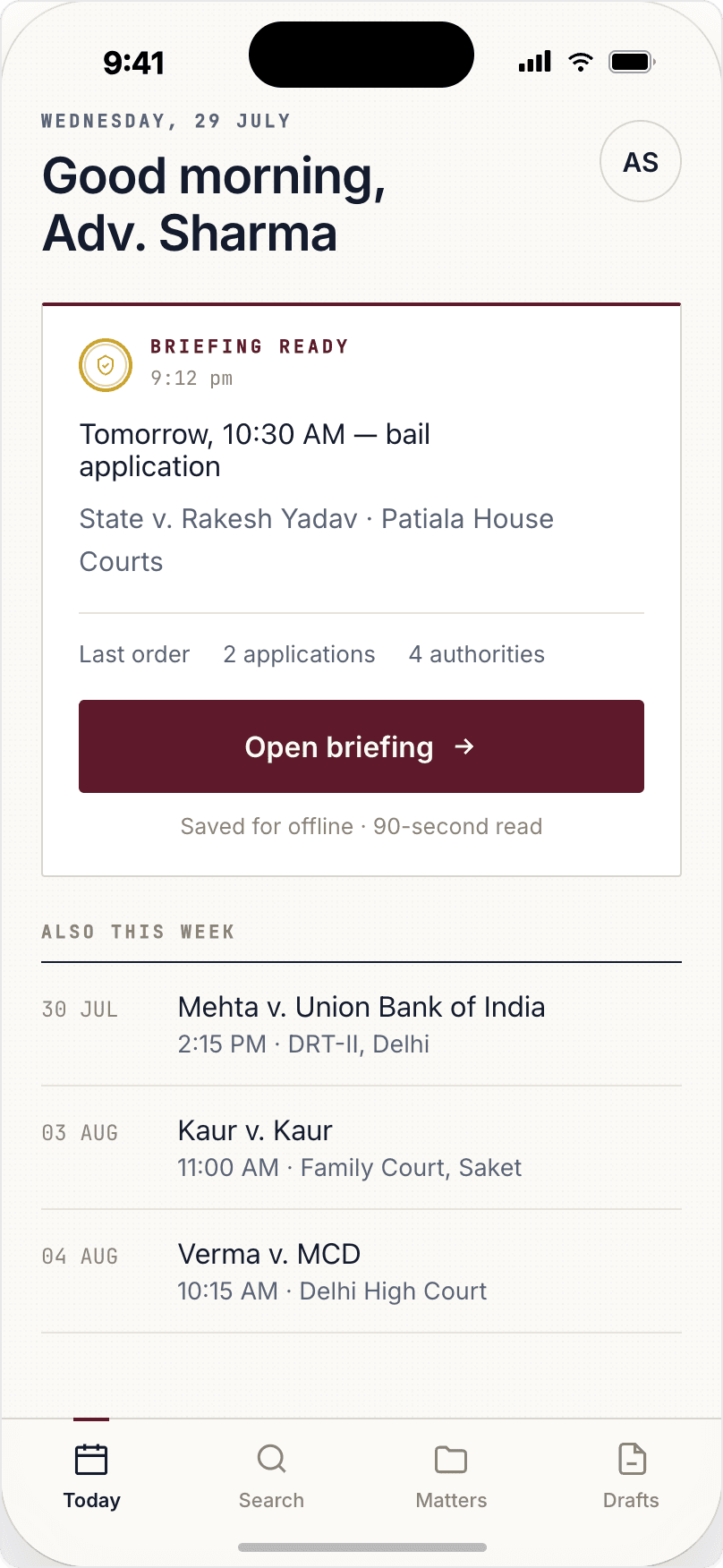
Tomorrow's listing, the night before.
The daily loop
Everyone else sells a database. The database is not the bottleneck. The evening before a hearing is.
Your matter is listed for tomorrow. Lawmind sees it and starts work without being asked.
Every authority your matter relies on is re-checked for whether it still stands. Verification does not expire; good law does.
Where the matter stands, what is pending, the authorities on the live issue, and a preparation checklist. Delivered by push, readable offline.
Ninety seconds in the corridor is enough, because the work was done last night. The matter workspace keeps all of it.
What actually arrives
Four sections, in the order you need them when you are standing up and the matter is called in ten minutes.
The listing appears, and the briefing is built overnight. You do not open an app and start a search.
Posture, pending applications, the live issue, a checklist. In that order, because that is the order you need them in a corridor.
Silence means confirmed. Only the exception speaks, and it tells you where to check it yourself.
Saved to the phone before you leave. Court buildings have terrible connectivity and that is not treated as an edge case.
Four features
The library prevents a comparison loss. The daily loop is what makes the app worth opening tomorrow.
The 24-hour briefing
A listed hearing becomes a briefing: where the matter stands, what is pending, authorities on the live issue, a preparation checklist.
How briefings workCourt decision search
Five judgments with title, citation, court, date, a two-sentence holding and the operative paragraph.
How search worksDrafting
Ten document types. Structured input becomes a court-format draft you edit paragraph by paragraph, then export to Word or PDF.
How drafting worksThe matter workspace
Per-case history: drafts, research, briefings, notes, hearing timeline. Everything the matter has accumulated, in one place.
How the workspace worksSwipe
A listed hearing becomes a briefing: where the matter stands, what is pending, authorities on the live issue, a preparation checklist.
It arrives by push the evening before and reads offline, because court buildings have terrible connectivity and you will open it standing up.
Five judgments with title, citation, court, date, a two-sentence holding and the operative paragraph.
How search worksTen document types. Structured input becomes a court-format draft you edit paragraph by paragraph, then export to Word or PDF.
How drafting worksPer-case history: drafts, research, briefings, notes, hearing timeline. Everything the matter has accumulated, in one place.
How the workspace worksVerification
An advocate who files a document citing a case that does not exist is humiliated in open court. Lawmind is built so that cannot happen to you.
It only ever references judgments handed to it from retrieved context. Every field you see (the title, the citation, the court, the date) is read from the record, not generated.
A citation is confirmed against our corpus, against independent public sources, or through the official eCourts record. Each is a separate check.
Verified is the expected state, so it carries no badge. Decorating the normal case on every row is noise, and it reads as defensive about the one thing that should be confident.
A citation no tier confirms is shown and marked plainly, with the path to check it yourself on eCourts. It is never quietly dropped and never dressed up as confirmed.
Whether a judgment still stands is asked live, every time it renders, and never cached. A judgment can be genuine and no longer good law. Those are different questions.
The 2024 criminal codes
On 1 July 2024 three new codes replaced the colonial-era criminal statutes. No frontier language model was trained on them, so every general-purpose AI still answers with the old sections.
Lawmind assists licensed practitioners. It does not advise the public, it never phrases output as advice to an end client, and it does not claim to be a lawyer.
Paragraph-level editing, citations locked. Word wins that fight and we are not having it.
You will keep carrying it. Lawmind is the preparation layer, not the file.
Free government sources are genuinely good now. A corpus is table stakes. What you are paying for is the evening before the hearing.
Questions
Lawmind is built for the evening before, on a phone, in Hindi or English, with every citation verified before it reaches you.
Founding advocates keep 50% off, permanently. First 5,000 only.